
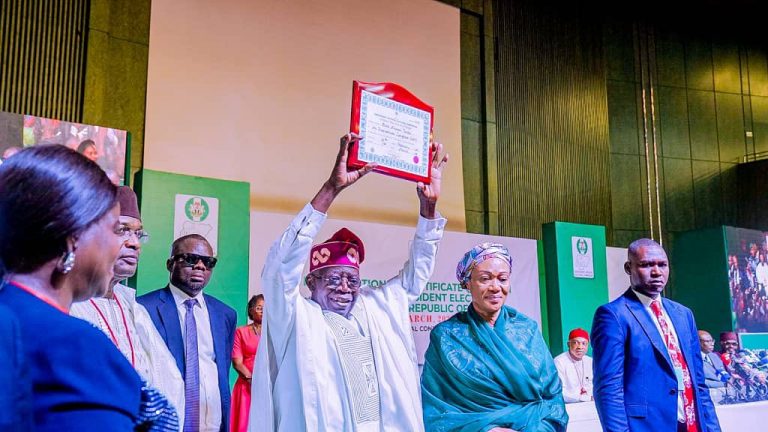
Seven states in Nigeria’s Peoples Democratic Party (PDP), including Adamawa, Akwa Ibom, Bayelsa, Delta, Edo, Taraba, and Sokoto, have discontinued their lawsuit against the Federal Government, challenging the victory of President-Elect Bola Tinubu in the February 25, 2023, presidential election. The suit was filed on the grounds that Tinubu’s declaration did not follow the provisions of the Electoral Act 2022 and the Independent National Electoral Commission’s guidelines. The states had also expressed concerns about a potential breakdown of public order and civil disobedience.
The suit, which had the Attorneys-General of the seven states as plaintiffs and the Attorney-General of the Federation as defendant, was seeking a declaration that the entire results of the presidential election were invalid, null, and void. The plaintiffs argued that the federal government through INEC “is empowered by law to correct the elections due to technical glitches and errors arising from the conduct of the elections with substantial effect on the electoral process in line with the provisions of Section 47 (3) of the Electoral Act, 2022; and other relevant sections thereof.
However, the plaintiffs have now asked the court to discontinue the suit, citing the conclusion of the election and the ongoing election tribunal as the next legal step. The plaintiffs had earlier expressed concerns about the collation of national election results and the failure of INEC to upload the results to the IReV through the BVAS, alleging that the electoral process was fundamentally flawed.
The withdrawal of the suit by the PDP-led states comes amid heightened tensions and protests across Nigeria, following the announcement of Tinubu’s victory. The opposition party, the PDP, had alleged irregularities and rigging in the election, and had called for the results to be overturned.
The discontinuation of the suit could be seen as a strategic move by the PDP to focus their efforts on the ongoing election tribunal, which would provide a legal avenue for challenging the election results. The tribunal, which is composed of judges, has the power to hear and determine election petitions arising from the conduct of the presidential and national assembly elections.
The withdrawal of the suit could also be an indication of a possible settlement or agreement between the PDP-led states and the federal government. It remains unclear if the PDP-led states would pursue other legal options to challenge the election results, or if they would accept Tinubu’s victory and move on.
The conduct of free, fair, and credible elections is crucial for the stability and development of Nigeria’s democracy. It is essential for all stakeholders to respect the electoral process and the rule of law, and to work together to address any irregularities or concerns in a peaceful and lawful manner.
The discontinuation of the suit also highlights the importance of the role of the judiciary in resolving disputes and upholding the rule of law in Nigeria. The Supreme Court, which is the highest court in the land, has a crucial responsibility in ensuring that justice is done, and that the rights of citizens are protected.
It is important for the judiciary to remain impartial, independent, and free from external influence or pressure. The judiciary should be allowed to perform its constitutional duties without fear or favour, and in accordance with the principles of justice, fairness, and the rule of law.
The Nigerian judiciary has faced numerous challenges in recent years, including allegations of corruption and political interference. It is crucial for the judiciary to maintain its integrity and independence, and to be seen as a reliable and impartial arbiter in resolving disputes and upholding the rule of law.


