

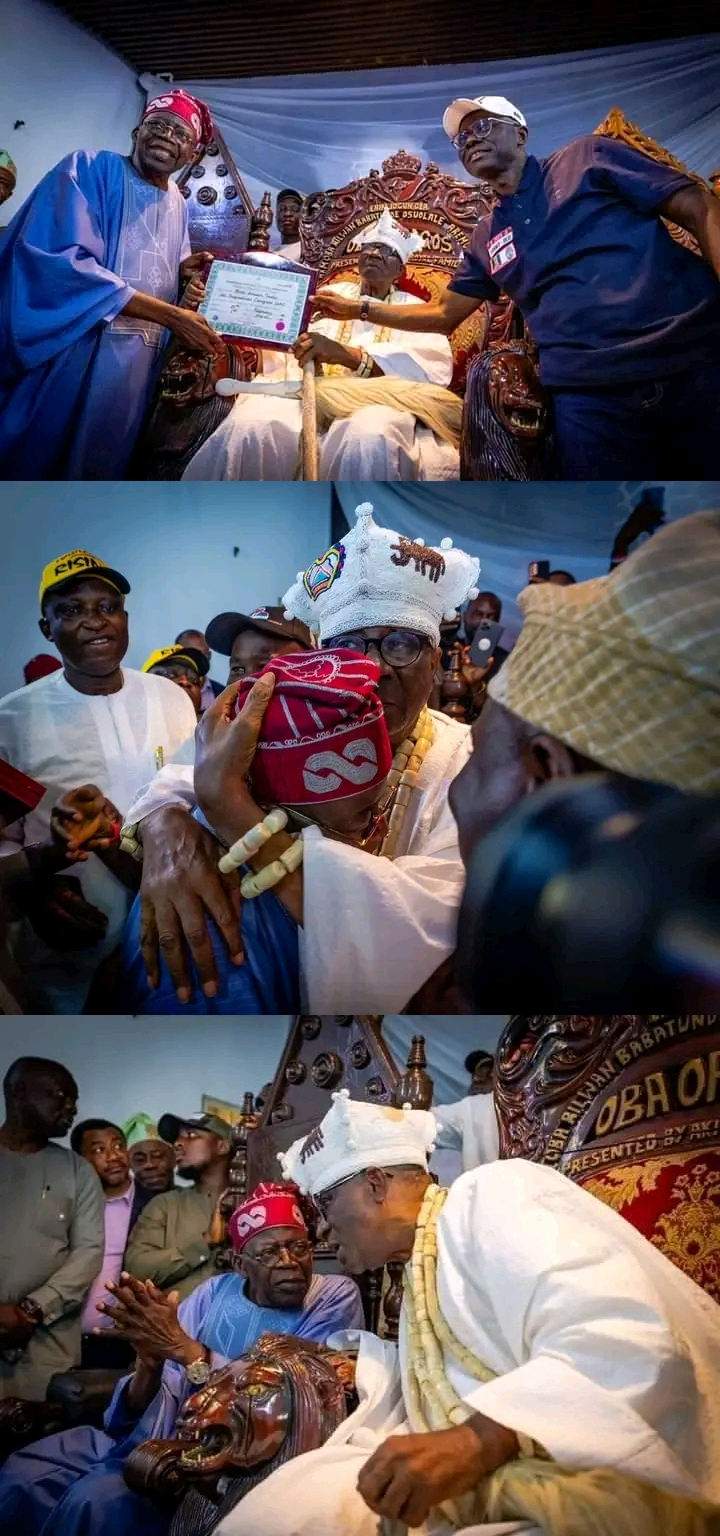
On Sunday, the president-elect, Bola Tinubu, made a visit to the Oba of Lagos, Rilwanu Akiolu, at his palace in Iga-Iduganran, Lagos State. As an experienced journalist, I had the privilege of covering the event. During the visit, Tinubu presented his Certificate of Return to the Oba as a sign of respect and honor. The atmosphere was charged with excitement and anticipation as a retinue of important dignitaries was present to witness the occasion.
Jokingly he Said to the Oba, “This certificate I just brought home is our own World cup” there was laughter everywhere by the people who graced the occasion.
Among those present were Lagos State Governor, Babajide Sanwo-Olu; Chief of Staff, Tayo Ayinde; former Lagos Deputy Governor, Femi Pedro; veteran politician Senator Musiliu Obanikoro; former Commissioner for Environment in Lagos, Muiz Banire and Woman Leader in the state, Jumoke Okoya-Thomas. The visit was a clear indication of the importance of traditional rulers in Nigeria’s political landscape and an affirmation of the need for continued collaboration between political leaders and traditional institutions.
As the visit progressed, the Oba of Lagos expressed his delight at receiving the president-elect in his palace and congratulated him on his recent electoral victory. Tinubu, in turn, thanked the Oba for his warm reception and promised to work closely with him and other traditional rulers in Lagos State to move the state forward.
The event was not only significant because it brought together important political and traditional leaders in Lagos State, but it also highlighted the importance of preserving cultural heritage and the traditional institution. The visit was a display of the respect and reverence accorded to traditional rulers in Nigeria, and it served as a reminder of the historical significance of the Oba of Lagos and other traditional rulers in shaping Nigeria’s cultural and political landscape.
As an experienced journalist, it was fascinating to witness the intersection of politics and tradition and to see firsthand how traditional institutions play a crucial role in Nigeria’s political and social fabric. The visit was a testament to the enduring strength and significance of Nigeria’s traditional institutions, and it underscored the need for political leaders to continue to collaborate with traditional rulers in Nigeria’s journey towards sustainable development and progress


